
Enterprise ERPs fail mid-market businesses by forcing rigid workflows onto agile teams. This creates massive financial drain, technical bloat, and requires expensive consulting hours just to achieve baseline operational functionality.
Why Do Enterprise ERPs Fail SMB Operations?
Enterprise ERPs fail mid-market businesses by forcing rigid workflows onto agile teams. This creates massive financial drain, technical bloat, and requires expensive consulting hours just to achieve baseline operational functionality.
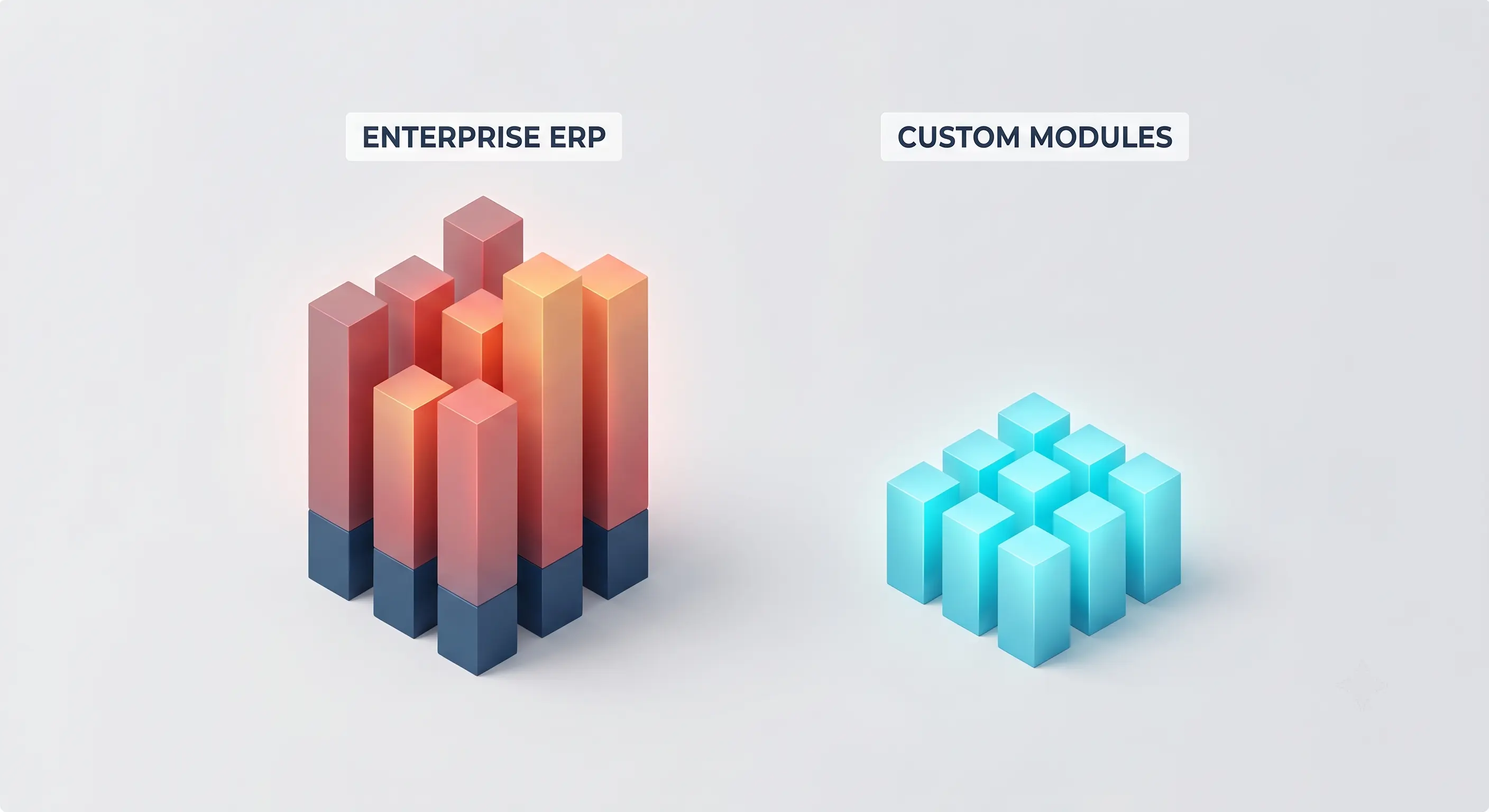
Middle-market executives face relentless vendor pressure to buy monolithic systems designed for Fortune 500 corporations. This creates severe Software Bloat and Subscription Sprawl, where businesses pay massive recurring licensing fees for tools their team will never use.
According to Pendo's Feature Adoption Study, 80 percent of software features are rarely or never used. This lack of adoption accounts for nearly $29.5 billion in wasted development and software spending. On top of that, Flexera's State of ITAM Report reveals that 32 percent of all SaaS and cloud spending is completely wasted.
Consider a practical warehouse scenario. A massive ERP forces your fulfillment team to click through eight different screens just to confirm a shipping label. Your employees bypass the system entirely. They revert to manual spreadsheets just to get orders out the door. You are paying premium enterprise licensing fees while your team ignores the software. To prevent this capital destruction, leaders must pivot toward targeted SMB software strategies that solve exact bottlenecks.
What Are Custom Operational Modules?
Custom Operational Modules are highly targeted software applications built to execute specific business processes. They integrate directly with your existing tools, providing exactly what you need without unnecessary technical bloat.
Rather than buying an all-in-one suite and forcing your company to adapt, modules are architected to match your competitive advantages. They interact via secure APIs, linking your accounting software, CRM, and inventory databases without a unified core replacement.
| Factor | Enterprise ERP System | Custom Operational Modules |
|---|---|---|
| Capital Expenditure | $500K+ initial, high recurring | Predictable, scoped project fees |
| Feature Utilization | 20% utilized, 80% waste | 100% utilized |
| Implementation Timeline | 12 to 24 months | 2 to 4 months |
| Operational Friction | Forces massive process changes | Built to mirror existing workflows |
What Are the 5 Signs You Need Custom Modules Over an ERP?
You need custom modules when suffering from unused subscription waste, fearing integration failures, lacking dedicated IT staff, requiring rapid deployment, or dealing with highly unique industry processes that ERPs ignore.
When evaluating system upgrades, operations and IT leaders should pivot to module development if they exhibit the following symptoms:
- You pay for capabilities you ignore: The ROI equation flips upside down when you fund features meant for massive enterprises.
- You fear fragile code: Altering monolithic systems pushes companies into catastrophic maintenance cycles.
- You lack Dedicated IT Overhead: ERPs require full-time administrators just to manage permissions, updates, and user support tickets.
- You need immediate improvements: Multi-year ERP deployments stall business momentum and freeze budgets.
- You have specific broken systems: A surgical legacy modernization approach fixes the broken workflows while preserving the functional ones.
Will Custom Modules Trap Us in Endless IT Maintenance?
Building isolated modules actually prevents maintenance traps by keeping your unique logic separated from third-party vendor code. This ensures system updates never break your tailored operational workflows or API connections.
The Customization Trap occurs when businesses modify rigid ERP core code to fit unique processes. This instantly breaks future upgrade paths and demands exorbitant consulting fees for ongoing maintenance. When an SMB writes custom scripts directly inside a proprietary ERP environment, they create permanent technical debt. Every time the vendor releases a mandatory security patch, the customized workflows break.
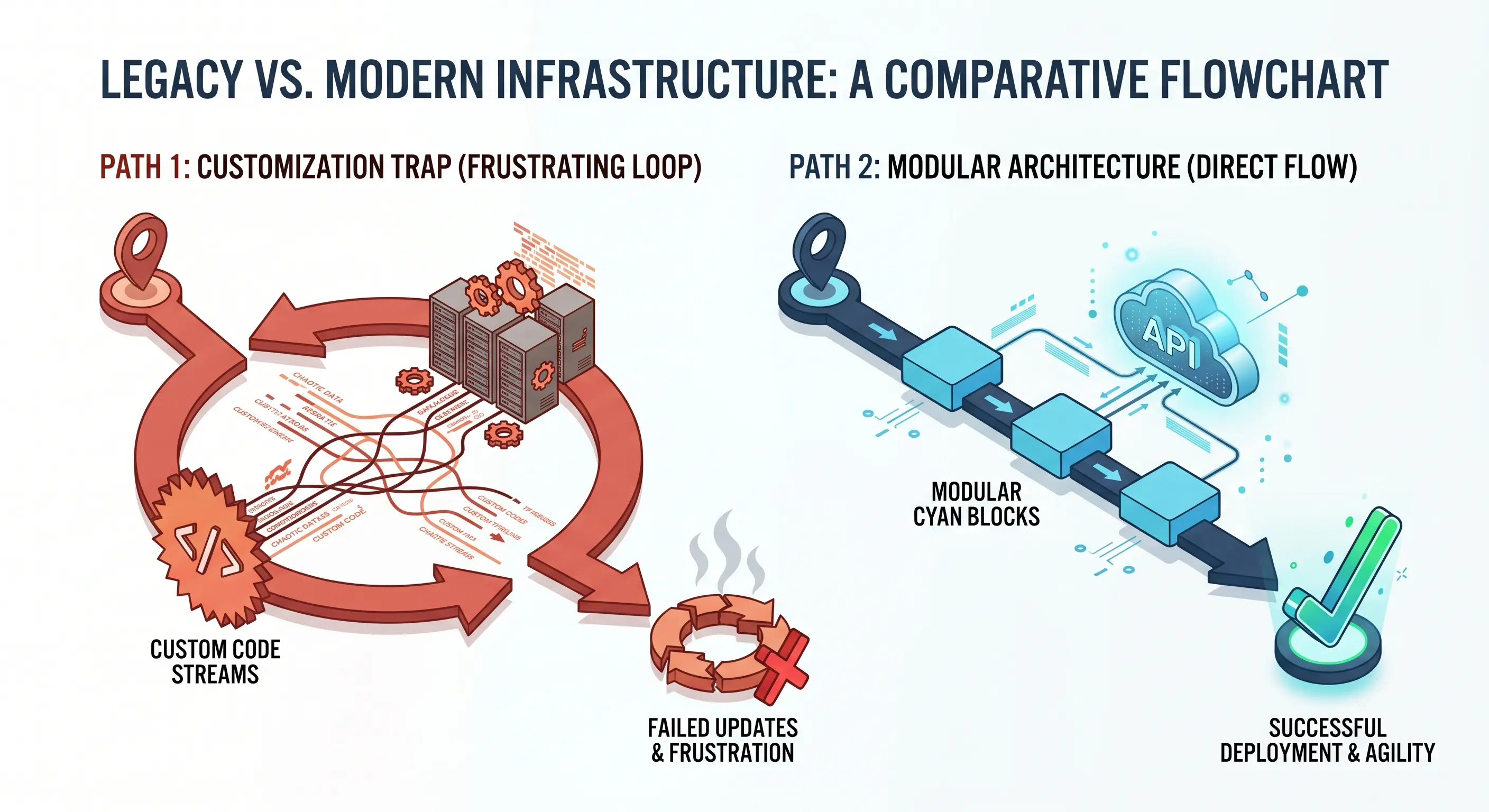
We bypass this risk using Agile Sprint Implementation. This approach delivers functional, high-value modules in weeks rather than years. You develop a lightweight, single-function module to solve one specific bottleneck. You deploy it, gather immediate user feedback, and move on to the next priority.
How Can 3ALICA Build Your Operational Modules?
3ALICA designs and deploys targeted custom operational modules that align perfectly with your workflows. Contact our engineering team today to audit your systems and map your risk-free module development plan.
Frequently Asked Questions
Why do enterprise ERPs fail mid-market businesses?
Enterprise ERPs fail mid-market businesses because they are designed for Fortune 500 corporations with rigid workflows that agile SMB teams cannot adapt to. This forces expensive consulting hours, creates technical bloat, and results in low user adoption where employees revert to spreadsheets instead of using the system.
What is a Custom Operational Module?
A Custom Operational Module is a highly targeted software application built to execute one specific business process. Unlike enterprise ERPs, modules integrate via secure APIs with your existing tools and are architected to match your workflows rather than forcing your company to adapt to pre-built logic.
How long does it take to deploy a custom operational module?
Custom operational modules can be deployed in 2 to 4 months using an Agile Sprint Implementation approach. This delivers functional, high-value modules in weeks rather than years, allowing businesses to solve one bottleneck at a time and gather real user feedback before building the next module.
Will custom modules require constant IT maintenance?
No. Custom modules prevent maintenance traps by keeping your unique logic separated from third-party vendor code. Unlike ERP customizations that break every time the vendor releases a security patch, modules are independent and can be updated without disrupting other systems.
How much does a custom operational module cost compared to an enterprise ERP?
Enterprise ERPs typically require $500K or more in initial investment plus high recurring licensing fees. Custom operational modules are scoped to specific problems, resulting in predictable project fees with no payment for unused capabilities. Flexera's 2024 State of ITAM Report found that 32 percent of all SaaS and cloud spending is wasted — modules eliminate that waste.
Sources:
- Pendo Feature Adoption Study (80% unused features, $29.5B wasted)
- Flexera 2024 State of ITAM (32% wasted SaaS spend)